
Sit-stand desks can reduce chronic low-back pain for many desk-based workers, but only when they're used to alternate postures throughout the day. A 2025 randomised trial and multiple systematic reviews back this up, though the effect is modest, not miraculous. Standing all day instead of sitting all day fixes nothing. The variation is what works.
TL;DR:
- Fixed sit-stand routines, such as 30 minutes sitting followed by 15 minutes standing, outperform unstructured efforts and personalized "stand when needed" approaches.
- Alternating postures with movement, especially incorporating walking and stretching, reduces static compression and improves blood flow to lower back tissues, benefiting chronic non-specific pain.
- Proper ergonomic setup, including adjustable desk height, monitor arms, supportive footwear, and anti-fatigue mats, prevents new strain that can negate the benefits of standing.
- Prolonged standing without movement can produce discomfort similar to sitting, making routine variation and short breaks essential for back pain relief.
- Long-term benefits depend on consistent use and reminders, as adherence to a scheduled routine is more effective than sporadic or fixed-height use.
Table of Contents
- How sit-stand desks help with back pain
- What does the strongest research actually show?
- How should you actually use a standing desk to reduce pain?
- What ergonomic setup actually prevents pain instead of causing it
- When is a standing desk not the answer?
- Which back pain conditions actually respond to a standing desk?
- Standing desks versus traditional desks: what actually changes for your back?
- Which stretches and movements help most during a standing desk routine?
- What happens after months or years of using a standing desk?
- Ulti's approach to ergonomic standing desks
- If you're ready to buy: how Ulti supports a safe transition
- Sources
- FAQ
How sit-stand desks help with back pain
The mechanism is simpler than most marketing copy suggests. Sitting still for hours loads the same spinal discs and ligaments in the same way, and standing rigidly does the exact same thing to a different set of tissues. Neither posture is the villain. Staying locked in one position is the problem, because static loading, whether seated or upright, restricts blood flow to spinal structures and leaves certain muscle groups switched off for hours at a stretch.
Alternating between sitting and standing recruits different muscles, redistributes pressure through the spine, and encourages small, unconscious movements that keep tissue from stiffening. That's why a Cochrane-style systematic review frames the benefit as coming from breaking up static posture, not from standing itself.
The effect size in trials tends to be modest rather than dramatic. Nobody should expect a standing desk to erase chronic pain overnight. But for the right person, used the right way, it's a genuine tool.
Who tends to see the most benefit:
- Office-based workers with chronic non-specific low-back pain (pain without a clear structural cause like a slipped disc or fracture)
- People whose pain worsens predictably after long unbroken periods at a desk
- Workers who can realistically build movement breaks into their day, not just install a desk and hope
If your pain is acute, recent, or linked to an injury, the calculus is different, and later sections cover exactly when to stop self-managing and see someone qualified.
What does the strongest research actually show?
The best current evidence points in one direction: fixed, scheduled alternation beats "stand when you feel like it," and standing alone beats nothing, but only marginally.
The headline number: in a 2025 randomised trial of 56 desk-based workers, a fixed schedule of 30 minutes sitting followed by 15 minutes standing cut worst lower-back pain by 1.33 points on a 10-point scale and average pain by 0.83 points after three months, outperforming a personalised "stand when needed" approach. Source: randomised trial, 2025.
That's not a cure. It's a meaningful, measurable reduction in a chronic condition that often responds to nothing at all, which is precisely why researchers took notice.
Wider systematic reviews confirm the pattern while tempering expectations:
- The Cochrane-style review by Parry et al. found sit-stand workstations produce modest reductions in low-back discomfort, but the underlying studies are heterogeneous and rarely track people beyond a year.
- A 2020 meta-analysis of laboratory-controlled trials found that prolonged static standing produces similar, or no better, pain ratings than prolonged sitting. Both postures hurt if held too long.
Put together, the evidence doesn't support "stand more" as a strategy. It supports "vary more," with standing as one half of the equation and movement as the other.
How should you actually use a standing desk to reduce pain?
The routine matters more than the desk. Here's a practical sequence based on what the trial evidence actually tested, not on generic wellness advice.
- Start with a fixed ratio, not a feeling. The 2025 trial used 30 minutes seated to 15 minutes standing, cycling through the working day. That fixed rhythm outperformed letting people stand whenever they felt like it, largely because willpower is an unreliable scheduling tool.
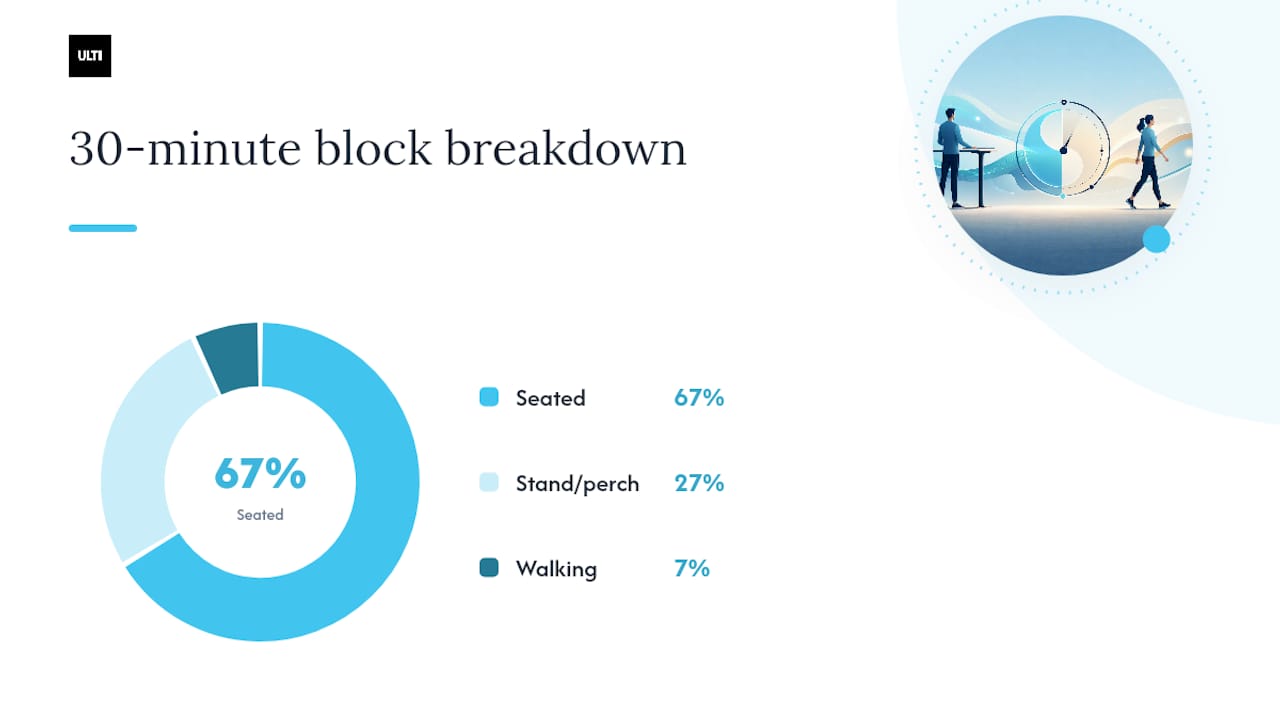
- Layer in the 20-8-2 principle. Within each half-hour block, aim for roughly 20 minutes seated, 8 minutes standing or perching against a stool, and 2 minutes actually walking, whether that's to refill a glass of water or pace during a phone call.
- Never skip the walking minutes. Occupational research is clear that swapping sitting for prolonged standing without movement doesn't help, and can introduce its own discomfort in the legs and lower back.
- Match the schedule to the task. Deep-focus writing or coding sits better with longer blocks and gentler transitions; admin work, calls, and email are easier to interrupt with a stand-and-stretch.
- Automate the reminder if you know you'll ignore a manual one. Presence-sensing or timer-based desk controllers help people maintain a rhythm when they'd otherwise forget to move for two hours straight.
Pro Tip: Set your first standing block to just 10 minutes, not 15, for the opening week. Muscles and feet that haven't held standing posture in years need a short runway before they can hold a full block without new soreness showing up the next morning.
Public health guidance from resources like MedlinePlus echoes the same underlying logic: frequent short breaks from sitting, rather than one rigid formula, are what reduce sedentary strain over the course of a working day.
What ergonomic setup actually prevents pain instead of causing it
A badly sized desk can undo everything the sitting-standing alternation is supposed to achieve. Get the measurements wrong and you trade one source of back pain for another.
- Seated position: elbows at roughly 90 degrees, wrists neutral on the keyboard, top of the screen at eye level.
- Standing position: the same three rules apply, just raised. Your desk needs to travel far enough upward that your shoulders don't hike to reach the keyboard.
- Minimum height matters as much as maximum. A desk that can't drop low enough for a shorter user's seated posture forces the shoulders up and the neck forward, which can create pain that has nothing to do with the lower back at all.
- Anti-fatigue mats reduce foot and calf strain during standing blocks, and supportive footwear helps more than most people expect.
- Monitor arms let you push the screen back and up rather than perching a laptop on a stack of books, which is one of the most common causes of forward neck flexion during standing use.
- Chair adjustments still count. A standing desk doesn't retire your chair. Seat depth, lumbar support, and armrest height all need to hold up their end during the sitting half of the cycle.
Ulti's standing desk height and sizing guide walks through exact measurements for different heights, and the ergonomic home office setup guide covers monitor and keyboard placement in more depth if you want to get the whole desk right in one pass.
When is a standing desk not the answer?
Some symptoms need a clinician, not a schedule change. Pain that radiates down a leg, new numbness or weakness, or pain following an injury are red flags that sit outside what any desk can fix.
If any of these show up, see a GP or physiotherapist and bring a clear history: when the pain started, what movements or postures trigger it, and any prior imaging or diagnoses. A standing desk works best as one part of a broader plan that might include targeted exercise, physiotherapy, or medication, not as a stand-alone treatment for pain with a clear structural or neurological cause.
Which back pain conditions actually respond to a standing desk?
Not every type of back pain reacts the same way, and knowing which category you fall into changes what to expect.
Chronic non-specific low-back pain is the condition with the clearest supporting evidence. This is pain without an identifiable structural cause, often linked to prolonged static posture, weak postural muscles, or general deconditioning. It's exactly the profile the 2025 trial and the wider systematic review literature focus on, and it's where alternating desks show the most consistent benefit.
Sciatica and radicular pain, where pain travels down the leg from nerve compression, sit in a different category entirely. Standing may temporarily ease pressure for some people by opening the space around the affected nerve root, while for others it aggravates symptoms depending on the exact location of compression. There's no reliable trial evidence that a standing desk resolves sciatica, and it should never be treated as a substitute for proper diagnosis and treatment.
Postural or muscular tension pain, often felt across the mid and lower back after long sitting stretches, tends to respond well to the same alternating routine that helps chronic non-specific pain, since it's frequently driven by the identical static-loading mechanism.
The practical takeaway: if your pain is diffuse, activity-related, and worse after sitting still, a standing desk used correctly is a reasonable and evidence-supported step. If it radiates, comes with numbness, or followed an injury, treat the desk as secondary to proper clinical assessment.
Standing desks versus traditional desks: what actually changes for your back?
A traditional fixed-height desk locks you into one posture for the entire working day, and that's the core problem, not the chair, not the monitor, not the keyboard. Every tissue in the lower back that could use a break simply doesn't get one.
A sit-stand desk doesn't outperform a traditional desk because standing is inherently better for your spine; the 2020 meta-analysis makes clear that prolonged standing carries its own discomfort. The advantage comes entirely from the ability to switch, something a fixed desk structurally cannot offer no matter how good your chair is.
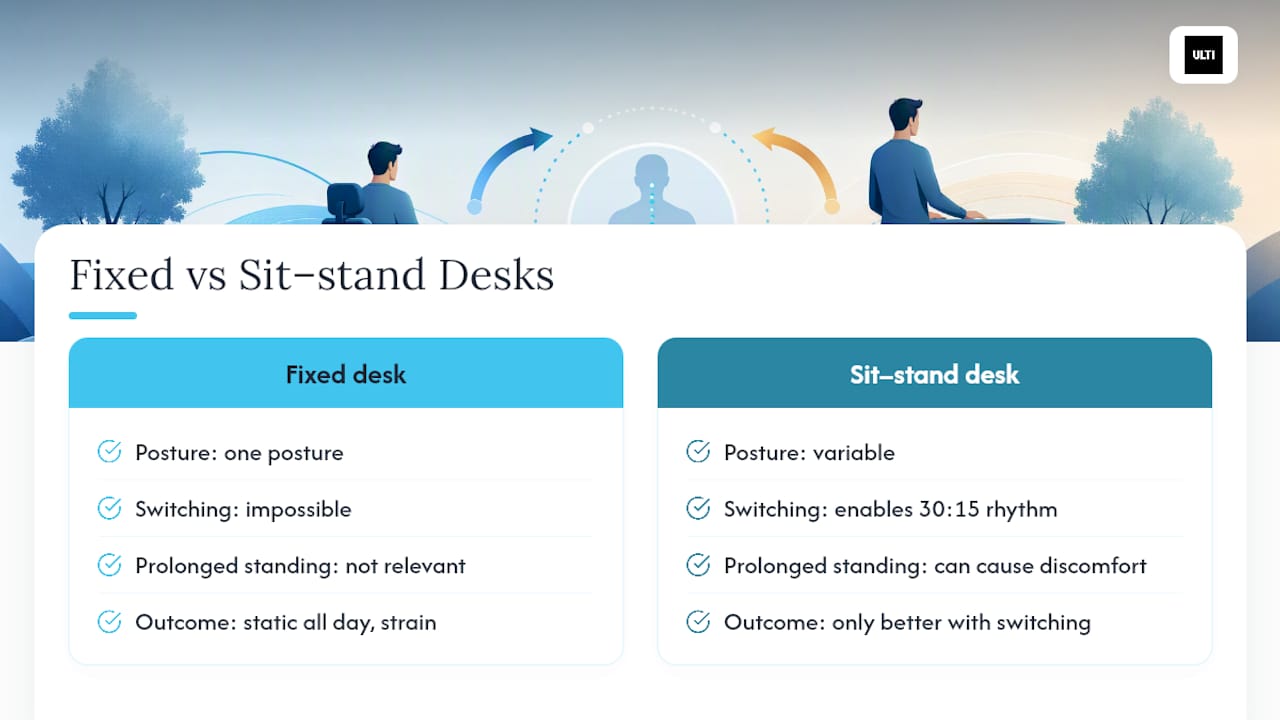
That distinction changes how you should judge the purchase. A standing desk bought and left in the "up" position all day delivers roughly the same outcome as a traditional desk, possibly worse if the height or monitor position is wrong. The value only shows up when the desk gets used as a switching tool, following something close to the 30:15 rhythm covered earlier. Traditional desks remain perfectly workable for people without back pain concerns, or for tasks that genuinely need long, uninterrupted seated focus. The comparison isn't standing against sitting; it's variation against staying still.
Which stretches and movements help most during a standing desk routine?
Movement inside the standing block matters more than standing itself. A few options that fit naturally into short breaks:
- Hip flexor stretches, since seated postures shorten these muscles and tight hip flexors pull on the lower back.
- Cat-cow spinal mobilisation, done standing by placing hands on the desk and gently arching and rounding the spine, to counter stiffness from static postures.
- Standing hamstring stretches, propping one heel on a low surface, which help offset the posterior chain tightness that builds up over a seated morning.
- Glute bridges or standing glute squeezes, since weak glutes are a common contributor to chronic non-specific low-back pain and don't get activated much in either sitting or standing alone.
- Short walks, the two minutes referenced in the 20-8-2 routine, which do more for spinal fluid movement and circulation than any static stretch performed in place.
None of these need special equipment or more than a minute or two, which is exactly the point: they're designed to slot into the transition moments the routine already builds in, not to become a separate workout you have to find time for.
What happens after months or years of using a standing desk?
Short-term trials, including the 2025 study, track outcomes at three months. What happens beyond that is murkier, and it's worth being honest about the gap.
Systematic reviews consistently flag the lack of long-term follow-up data beyond twelve months, which means nobody can say with confidence what a standing desk does for your back after five years of daily use. What the evidence does suggest is that adherence, not the desk's specifications, is the deciding factor. People who stick to a scheduled alternation pattern report sustained benefit; people who buy a desk, use it enthusiastically for a fortnight, then leave it permanently raised or permanently lowered tend to drift back toward their original pain levels.
This is where automated reminders and presence-sensing controls earn their keep, since the biggest long-term risk isn't a flawed mechanism, it's simply forgetting to use it. Desks with memory height presets removes some of that friction by making the switch a one-touch action rather than a manual adjustment each time, which matters more over a two-year horizon than it does in the first excited week of ownership.
Ulti's approach to ergonomic standing desks
Ulti builds electric sit-stand desks, ergonomic chairs, and monitor arms with the sizing question front and centre, because a desk that can't reach the right height for your body undoes the benefit this article has spent most of its length explaining. Our showroom lets you trial height ranges before buying, and our sizing guides and compatibility checkers exist specifically to stop shorter or taller users ending up with a desk that forces poor posture. If you want hands-on help getting the setup right rather than guessing from a spec sheet, that's exactly what we're here for.
— ULTI
If you're ready to buy: how Ulti supports a safe transition
The desk itself is only half the equation. The other half is getting a frame, height range, and accessories that actually fit your body and your workspace, which is where a lot of standing desk purchases go wrong.
Ulti's electric sit-stand desks use reinforced steel frames and dual-motor height adjustment, with built-in cable management so the transition from sitting to standing doesn't leave cords dragging across the floor. If chronic back pain is part of what's driving the purchase, pair the desk with an ergonomic mesh chair that adjusts for seat depth and lumbar support, since your chair still does most of the work during the seated half of any sit-stand routine. A monitor arm keeps your screen at eye level across both postures, which avoids the forward neck flexion that undermines an otherwise correct setup.
For anyone unsure about measurements, Ulti's showroom in Singapore lets you trial desk heights in person before committing, and the installation service handles assembly and cable routing so the desk is ready to use correctly from day one rather than sitting half-built in a box. Measure your current desk height, check it against a sizing guide, then book a showroom visit or place an order when you're ready to move.
This article is general information, not a substitute for advice from a qualified doctor. Consult a qualified healthcare professional about your own circumstances before acting on anything here.
Sources
- Randomised trial (2025) comparing fixed sit:stand ratio vs personalised approach
- Cochrane-style systematic review (Parry et al., 2019)
- Systematic review/meta-analysis on prolonged standing vs sitting (2020)
FAQ
Can standing desks cause back pain?
Yes, if used incorrectly. Standing continuously for long stretches without movement can produce the same static-loading discomfort as prolonged sitting, and a desk set at the wrong height can create new neck or back strain regardless of posture.
What is the 20-8-2 rule for standing desks?
It's a movement pattern within each 30-minute work block: roughly 20 minutes seated, 8 minutes standing or perching, and 2 minutes walking. The walking minutes are the part most people skip, yet they're what occupational research links to the actual benefit.
Is standing all day bad for your back?
Standing all day offers no clear advantage over sitting all day for back pain, according to a 2020 meta-analysis of laboratory-controlled trials. Both static postures produce discomfort when held for extended periods; alternating between them is what helps.
What are the downsides of using a standing desk?
The main downsides are leg and foot fatigue during long-standing blocks, and the risk of buying a desk that can't reach a correct height for your body, which can worsen posture rather than improve it. Ulti's sizing guide covers minimum and maximum height needs to avoid this exact problem.
How much does an Ulti standing desk cost?
Pricing depends on the model and configuration, and current prices are listed on Ulti's site rather than fixed at a single figure across the range.