
A published weight capacity is a manufacturer-tested rating, not a cliff edge you fall off the moment you cross it. Standard chairs are usually rated between 90 and 113 kg (200 to 250 lb), heavy-duty models push to 227 kg (500 lb), and specialist bariatric ranges go higher still. The practical rule: pick a chair rated with a comfortable margin above your bodyweight to ensure daily wear and tear does not approach the limit.
TL;DR:
- Chairs rated up to 113 kg are suitable for most office users, but exceeding one category's upper limit risks accelerated wear and potential failure.
- The rated capacity is based on static tests and does not account for dynamic movements like leaning or twisting, so always leave a safety margin above your body weight.
- The gas cylinder and base are the primary components determining a chair’s true support ability, with reinforced materials essential for higher load capacities.
- Buying a chair with the correct weight rating and well-documented specifications, including test standards and warranty, helps ensure durability and safety.
- For heavier users or those needing long-term support, choosing a higher-rated, reinforced chair from reputable brands like ULTI provides better long-term performance.
Table of Contents
- What does an office chair weight capacity number actually mean?
- What weight can an office chair support by chair type?
- Which parts actually set an office chair's weight limit?
- What happens if you exceed an office chair's weight rating?
- How do you choose the right weight capacity for your chair?
- What should you check on a product page before buying?
- How ULTI approaches capacity and durability in chair design
- When should weight capacity be your top priority?
- Find the right high-capacity chair with ULTI
- Sources
- FAQ
What does an office chair weight capacity number actually mean?
That figure on the product page almost always comes from a static test. A manufacturer loads the seat with a fixed weight, holds it there, and checks that the frame, cylinder, and base don't fail. Everyday sitting is nowhere near that gentle. You drop into the chair after a long meeting, lean back sharply to stretch, or shift your weight while twisting to grab a file. These are dynamic loads, and they hit the same components far harder than a static test ever does, which is exactly why published capacity figures often understate real-world stress.
This is where headroom earns its keep.
- Static test: fixed load, no movement, ideal conditions.
- Dynamic use: leaning, twisting, and dropping into the seat repeatedly.
- Headroom: the buffer between your bodyweight and the rated limit.
Pro Tip: Think of the rated capacity as the chair's absolute ceiling under laboratory conditions, not its comfortable working limit for daily life.
What weight can an office chair support by chair type?
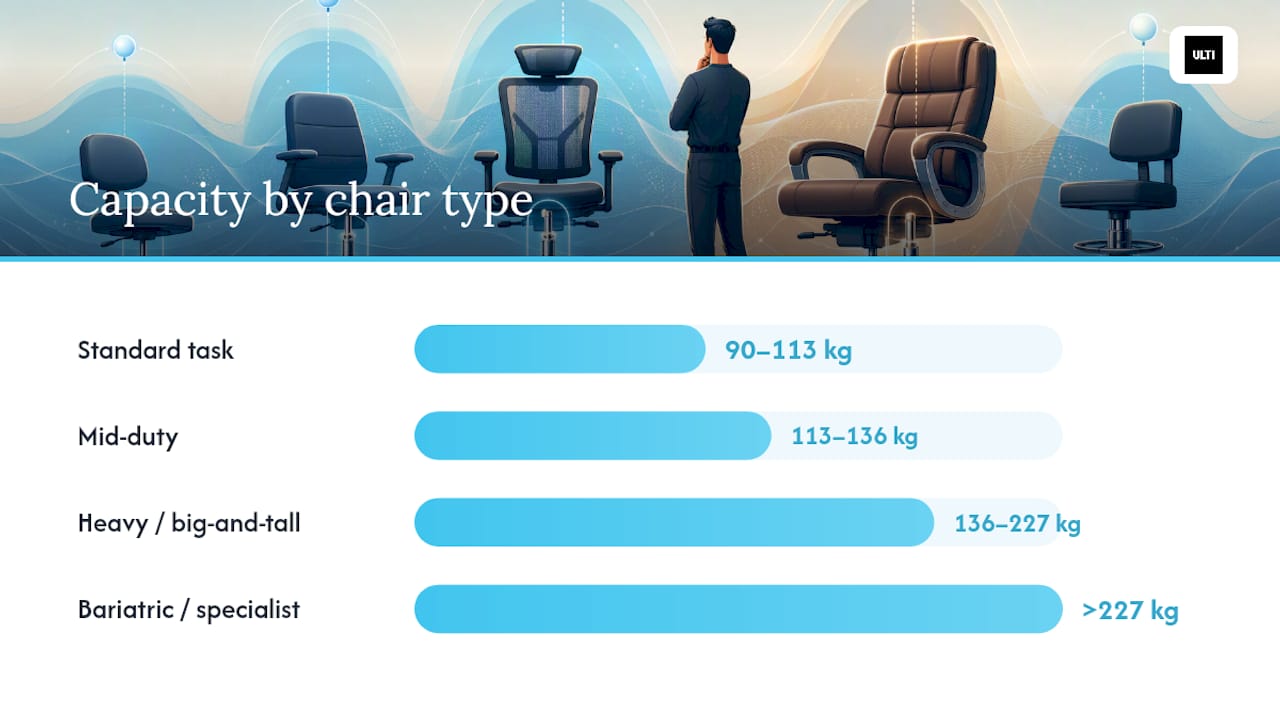
Capacity ranges track fairly closely with chair category, and knowing where you fall makes shopping far quicker. Standard task chairs typically sit around 90 to 113 kg (200 to 250 lb), which covers most general office seating. Mid-duty chairs step up to roughly 113 to 136 kg (250 to 300 lb), often with a slightly wider seat pan and a beefier cylinder. Heavy-duty and big-and-tall chairs run from about 136 to 227 kg (300 to 500 lb), and specialist bariatric lines go beyond 227 kg (500 lb) again for clinical or occupational settings.
Higher-rated chairs rarely just swap in a stronger cylinder and leave everything else the same. You'll usually find:
- Wider and deeper seats to properly distribute weight across the frame.
- Reinforced steel or cast bases instead of standard nylon.
- Heavier-duty gas cylinders rated for the extra load.
If you're using a chair for multiple shifts, sitting near the top of a category's range most days, or working in a clinical or occupational environment, it's worth stepping up a tier rather than buying right at the edge of what a standard chair offers.
Which parts actually set an office chair's weight limit?
The number on the box is really a summary of four components working together, and any one of them can become the weakest link. The gas cylinder and the base typically determine the honest ceiling of a chair's strength, because they carry the load directly and take the brunt of every sit, lean, and height adjustment.
- Gas cylinder class: heavier-duty cylinders are built with thicker walls and rated for higher, more frequent loads.
- Base material and footprint: reinforced steel or cast aluminium resists splay and cracking far better than standard nylon, and a wider footprint improves stability under weight.
- Mechanism and casters: the tilt mechanism needs to hold its adjustment under load, and casters rated for heavier users won't crack or seize as quickly.
Interestingly, capacity can drop on taller stool variants of the same seat, because a taller cylinder and a smaller base footprint create more leverage and less stability, even with identical upholstery and cushioning.
Pro Tip: If a product listing shows the capacity figure but hides the base material or cylinder class, treat that as a gap in the specification, not a reassurance.
What happens if you exceed an office chair's weight rating?
Exceeding a chair's rated capacity rarely causes sudden collapse. What actually happens is progressive, and it's arguably worse because it's harder to notice until something gives out mid-task. Overloading accelerates wear on the gas cylinder and base and often voids the warranty long before any dramatic failure occurs.
Here's the typical failure sequence, in order of how often it shows up:
- Cylinder failure: the seat slowly loses height, sinks under load, or stops holding position.
- Base splay or cracking: the star base spreads or fractures at the arms, especially on nylon bases pushed past their rating.
- Mechanism wear: the tilt or recline function loosens, sticks, or fails to lock properly.
- Caster breakage: wheels crack or seize under sustained weight beyond their design load.
None of this is inevitable if you buy the right rating and treat the chair reasonably. Avoid repeatedly dropping hard into the seat rather than sitting down with control. Check and retighten the base and armrest fasteners every few months, since loose bolts multiply stress on the frame. And match your casters to your flooring and your weight, because a caster rated for light use on carpet will wear out fast under a heavier user on hard flooring.
How do you choose the right weight capacity for your chair?
Work through a short checklist before you buy rather than after something starts creaking. Look for the published capacity figure first, then check the cylinder class and base material listed alongside it. Warranty terms tell you how confident the manufacturer really is. Seat width and depth matter just as much as the number itself, since comfort and long-term fit depend on dimensions lining up with capacity.
- Published capacity figure, stated clearly on the product page.
- Cylinder class and base material named, not just implied.
- Warranty length and what it actually covers.
- Seat width and depth relative to your body size.
- At least 20% headroom above your current bodyweight.
Ask sellers directly: "What test standard was this rating based on, and does the warranty cover load-related wear?" If a listing is vague on any of these points, the safer move is choosing the next capacity tier up rather than assuming the lower-rated chair will be fine.
Pro Tip: When two chairs look identical in price and style, the one with a fuller specification sheet is almost always the more honestly rated of the two.
What should you check on a product page before buying?
A trustworthy listing gives you five things without making you dig: the explicit capacity figure, the cylinder class, the base material, a reference to a test standard such as ANSI/BIFMA, and clear warranty coverage. Products built for heavier or more intensive use, like chairs rated up to 500 lb with reinforced mechanisms, tend to state all five plainly because the manufacturer has nothing to hide behind vague wording.

If a listing skips this information entirely, that's a signal worth taking seriously. The absence of published hardware detail is itself a transparency gap, not a neutral omission. Ask for a manufacturer test report, request written warranty clarification covering load-related failure, and check the return policy before committing. When in doubt, choose the higher-rated model or contact the seller directly rather than guessing.
How ULTI approaches capacity and durability in chair design
Some ergonomic chairs and standing desks are built around reinforced steel construction, to prevent frame flexing under load from wearing out the cylinder and base prematurely. That same design philosophy, robust materials, paired with genuinely adjustable ergonomics, is what underpins ULTI's ergonomic chair range, and it's part of why the brand has earned endorsements from organisations that expect their equipment to hold up under daily professional use.
This isn't a comparative ranking against other manufacturers. It's an explanation of the design thinking behind the products: build the components that set the limit, the cylinder, the base, the mechanism, strong enough that the published figure reflects real confidence. For exact capacity specifications on any individual model, the product pages and showroom team can confirm the numbers for your specific situation.
When should weight capacity be your top priority?
Capacity deserves top billing if you're a heavier user, working multiple shifts, or need bariatric-grade support. For shorter sessions or shared desks with varied users, adjustability and fit often matter more than an extra 50 kg of theoretical headroom you'll never approach.
— ULTI
Find the right high-capacity chair with ULTI
ULTI is the practical next step once you know your target capacity: browse the ergonomic chairs category to compare published ratings, seat dimensions, and base construction side by side, instead of hunting through vague spec sheets across different retailers. Every model lists its capacity, cylinder class, and warranty terms up front, so you're not left guessing whether a listing is hiding something.

If you'd rather get matched automatically, the ergonomic chair finder takes your body dimensions and usage pattern and narrows the range to models with genuine headroom for your weight. Prefer to check a chair in person before buying? ULTI's Singapore showroom lets you sit in the actual model, test the recline mechanism, and ask the team directly about cylinder class or warranty coverage. Start with the chair finder or the category page, and you'll have a shortlist within minutes rather than hours of comparing spec sheets.
Sources
- Verycosy
- Office Chair Weight Capacity, Explained | Desk & Daylight
- Office Chair Weight Limit: 4 Questions Every Customer Asks
FAQ
How much weight can an office chair support?
Most standard office chairs support 90 to 113 kg (200 to 250 lb), while heavy-duty and big-and-tall models range from 136 to 227 kg (300 to 500 lb) or higher in specialist bariatric lines.
How much weight can a chair hold in kg?
Standard chairs typically hold 90 to 113 kg, mid-duty chairs around 113 to 136 kg, and heavy-duty chairs from roughly 136 kg up to 227 kg or beyond in specialist designs.
What chairs can hold 150 kg?
A chair rated in the heavy-duty range, generally 136 kg and above, comfortably covers weights with sensible headroom; check that the listing names its cylinder class and base material to confirm the rating is genuine.
What is the best office chair for heavy weight capacity?
Look for a model with an explicit high-capacity rating, a reinforced steel or cast base, and a heavier-duty gas cylinder. ULTI's ergonomic chair range publishes these specifications clearly so you can match capacity to your bodyweight before buying.