
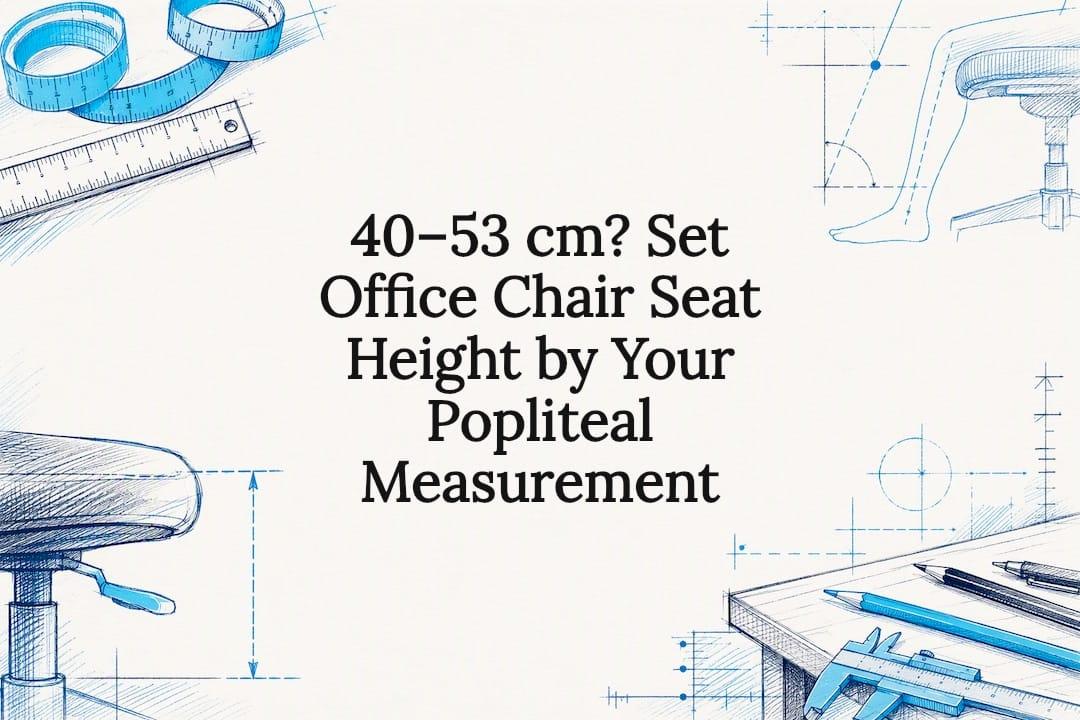
Set the seat so your feet are flat, your knees are level or slightly below your hips, and the seat height matches your popliteal measurement, the distance from the floor to the crease behind your knee. Most gas-lift chairs adjust across a similar band, but proportions vary enough that a height-only rule can mislead you. OSHA guidance and sizing guides usually point to measurement, not guesswork, as the reliable starting point.
TL;DR:
- Most office chairs with gas lift adjustments suit heights between 40 and 53 centimeters, but measuring popliteal height ensures a proper fit instead of relying solely on range estimates.
- Popliteal height measurement involves sitting on a flat surface with shoes on, bending the knee at a right angle, and measuring from the knee crease to the floor.
- Proper seat height allows your feet to rest flat and knees to be level or slightly below hips, reducing circulation issues and lower back strain.
- Seat depth and lumbar support should be adjusted to maintain a two- or three-finger gap behind the knee for optimal thigh support and circulation.
- When desk height limits chair adjustment, a footrest should be used instead of compromising seat height, especially for very tall or short users.
Table of Contents
- What is the correct office chair seat height range?
- How do you measure popliteal height and test a chair?
- How do you adjust your office chair step by step?
- How do seat depth and back support affect seat height?
- How does seat height affect desk and monitor position?
- When should you use a footrest instead of changing the chair?
- What happens when the seat is set too high or too low?
- Where does Ulti's approach to chair fitting come from?
- A five-minute test worth doing before you commit to any chair
- Get your seat height right the first time with Ulti
- Sources
- FAQ
What is the correct office chair seat height range?
Nearly all modern office chairs adjust across roughly 40 to 53 centimetres (about 16 to 21 inches) of gas-lift travel, a range that suits around three-quarters of adults. That figure is useful, but it's an average, not a guarantee. If you sit outside that middle band, the standard range simply won't get you to a neutral position, no matter how far you crank the lever.
Height bands give you a rough starting point before you fit-test:
- Around 150 to 160 cm tall: seat height typically sits near the low end, roughly 38 to 42 cm.
- Around 160 to 175 cm tall: most people land in the middle of the standard range, around 42 to 47 cm.
- Around 175 to 190 cm tall: seat height usually needs the upper end, roughly 47 to 52 cm.
- Above 190 cm or below 150 cm: standard gas-lift ranges often fall short in one direction, and a footrest or an extended-range chair becomes worth considering.
These bands exist because overall height correlates loosely with leg length, but the correlation is loose enough to catch plenty of people out. Someone who's 178 cm tall with proportionally short legs could need a seat height that "belongs" to someone 15 cm shorter. This is precisely why popliteal height, not stature, is the measurement that actually matters, and it's why a peer-reviewed chair-sizing study found that height-based equations have real limitations for older adults, younger users, and people with a higher body mass index.
Treat every number above as a hypothesis to test, not a setting to trust blindly. The chair either fits your body when you sit in it, or it doesn't, and the only way to know is to measure and then check.

How do you measure popliteal height and test a chair?
Popliteal height is the single most useful number in this whole exercise, and it takes about two minutes to find.
- Sit on a hard, flat surface, such as a dining chair or a step, with your hips pushed back and your thigh fully supported.
- Keep the shoes on that you'd normally wear at your desk. Sole thickness changes the final number, and skipping this step is the most common measuring mistake.
- Bend your knee to a right angle with your foot flat on the floor.
- Measure straight down from the underside of your thigh, right at the back of the knee crease, to the floor. That distance is your popliteal height.
- Use that figure as your target seat pan height, measured from the floor to the front edge of the seat.
Once you have the number, run the fit test. Sit in the chair with your feet flat and check for a two-finger gap between the front edge of the seat and the back of your knee. Your thighs should feel light contact with the seat, not pressure. Your lower back should meet the backrest's lumbar curve without you having to lean back deliberately, and there should be no tingling or numbness in your thighs after five minutes of normal sitting.
Pro Tip: Measure popliteal height at the end of the day rather than first thing in the morning. Minor swelling from a day on your feet can shift the reading by a centimetre or two, and you want the setting that works for your legs in their normal working state, not their most rested one.

How do you adjust your office chair step by step?
Adjustment order matters more than most people assume. Fix the seat height first, because every other setting on the chair, and on the desk, gets measured relative to where your hips end up.
- Set seat height to your popliteal measurement. Feet flat on the floor, knees level with or very slightly below hip height.
- Adjust seat depth and the backrest. Leave a two to three-finger gap behind the knee, and set the backrest so the lumbar curve sits in the small of your back.
- Set armrests last, not first. Shoulders should stay relaxed and level, not hunched up or drooping down to reach the rest.
- Recheck the keyboard and monitor. Once your hips and shoulders are settled, the rest of the desk needs to catch up to that new position.
A few micro-adjustments are worth making once the big settings are in place:
- If you feel pressure under your thighs rather than light contact, the seat is a touch high; drop it a centimetre and recheck.
- If your knees sit noticeably above your hips, the seat is too low for your leg length.
- Cold feet or a tingling sensation after sitting for a while often signals circulation restriction from a seat edge digging into the back of the thigh.
If your desk height is fixed and forces the chair higher than your popliteal measurement allows, bring in a footrest at this stage rather than compromising the seat height to compensate.
How do seat depth and back support affect seat height?
Seat depth and seat height aren't separate problems. Get one wrong and it undoes the other, even if the height number on its own looks correct.
The standard check is the two or three-finger rule: with your back against the lumbar support, you should be able to fit two to three fingers between the front edge of the seat and the back of your knee. Too little gap, and the seat edge presses into the crease behind your knee, restricting circulation and pushing you to slide forward, which then drags your lower back out of contact with the lumbar support entirely. Too much gap, and you lose thigh support and end up perching, which quietly increases strain through the lower back over a working day.
If your chair has a fixed seat pan and the depth doesn't suit your leg length, a sliding seat pan or an adjustable lumbar unit is the practical fix. Some chairs offer both; others need a lumbar cushion as a workaround.
- Sliding seat pan: lets you shorten or lengthen the depth independently of height.
- Adjustable backrest with height and depth lumbar controls: brings support to your spine rather than the other way round.
- A different chair entirely: sometimes the honest answer, particularly for shorter or taller users on a fixed-depth model.
How does seat height affect desk and monitor position?
Seat height decides where your hips sit, and your hips decide where your elbows, wrists, and eyes end up relative to the desk. Get the seat right and the desk wrong, and you've solved half a problem.
Elbows should sit at roughly 90 degrees, or slightly open, when your hands rest on the keyboard, according to Mayo Clinic guidance on desk posture. If your popliteal-correct seat height leaves your elbows below the keyboard, the desk is too high for you, not the chair too low, and that's the moment to raise the desk rather than drop the seat back down. This is exactly where an electric height-adjustable desk earns its keep, since a fixed desk locks you into one compromise or another.
Once the seat and desk agree, check the monitor.
- The top third of the screen should sit near eye level, so you're looking slightly down at the main content, not straight ahead or up.
- Screen distance should be roughly an arm's length away.
- After any seat height change, recheck monitor height. A two-centimetre seat adjustment can shift your eye line enough to matter.
- If raising the desk isn't possible, a footrest protects the seat height without forcing a keyboard compromise.
When should you use a footrest instead of changing the chair?
A footrest earns its place whenever the desk, not the chair, is the limiting factor. If a fixed-height desk forces your seat higher than your popliteal measurement to get your elbows level with the keyboard, your feet lose contact with the floor, and that's the exact situation a proper footrest solves.
Look for a stable, non-slip surface with some tilt adjustment rather than a flat box or a stack of books, which shift underfoot and rarely sit at the right angle. Petite users and very tall users both hit the limits of standard gas-lift ranges more often, and in either case, a chair with extended-range adjustment is a better long-term answer than living permanently on a footrest.
- Avoid: stacked books, upturned bins, or anything without a stable, wide base.
- Prefer: a purpose-built footrest with tilt control and a non-slip top.
Pro Tip: A footrest fixes a desk-height mismatch. It doesn't fix a chair that's genuinely too small or too large for you, so don't reach for one as a permanent substitute for the right size chair.
What happens when the seat is set too high or too low?
A seat set too high leaves your feet dangling or forces you onto your toes, and you'll usually notice tingling in your calves or shoulders creeping up towards your ears as you compensate. Drop the seat until your whole foot rests flat, then recheck shoulder position at the armrests.
A seat set too low pushes your knees above your hips and rounds your lower back, particularly during the sit-down motion itself. A 2022 motion-analysis study found that seats set at roughly 60% of lower-leg length produced noticeably more lumbar flexion when sitting down than seats at full length, a detail that matters if you've lowered your chair to solve a desk-height problem rather than raising the desk instead.
- Slipping forward on the seat: usually means the seat is too deep; try a sliding seat pan or add lumbar support.
- Pressure or numbness behind the knee: the seat is too high, too deep, or both; recheck height and depth together.
- Persistent pain or numbness that doesn't resolve with adjustment: stop troubleshooting alone and get it reviewed by a physiotherapist or occupational health professional.
Where does Ulti's approach to chair fitting come from?
Ulti built its "How to adjust an ergonomic chair" guide around the same measurement-first logic covered here, because guessing at a seat height wastes both money and comfort. The case for measuring rather than estimating isn't a house opinion. It's backed by OSHA's own chair guidance and by peer-reviewed research into chair sizing that flags exactly where height-only rules break down.
If you'd rather not measure everything yourself, that's a reasonable call too. Ulti's chair finder tool matches body measurements to suitable models, and the Singapore showroom lets you sit in a chair before it's yours, with the installation team on hand if you'd rather have the whole setup fitted properly the first time.
A five-minute test worth doing before you commit to any chair
Sit down and do a short task, type for a minute, then check three things: does your lower back touch the lumbar support without effort, do your feet rest flat without reaching, and is there any pressure behind your knees? If any answer is no, stop and re-measure rather than assuming you'll adjust to it over time.
— ULTI
Get your seat height right the first time with Ulti
Some vendors sell measurement-first fits rather than one-size-fits-all seats. The ergonomic chairs range includes seat depth adjustment and lumbar controls built in, so you're not stuck compensating for a fixed pan with cushions and workarounds.
If you're not sure which model matches your popliteal measurement and desk setup, the chair finder tool takes your numbers and narrows the shortlist for you. Prefer to sit in it first? Book a showroom visit and pair it with the installation service so the chair, desk, and monitor arm all land at the right heights on day one rather than after weeks of fiddling. Start with the chair finder or browse the ergonomic chairs range to see what fits your measurements.
Sources
- Computer workstations - chairs | OSHA eTools
- How to select the office chair that’s right for you | WIRED
- Peer-reviewed motion-analysis study (2022)
- Peer-reviewed chair-sizing study (MDPI) | 2023
FAQ
What is the ideal seat height for an office chair?
The ideal seat height matches your popliteal measurement, the distance from the floor to the back of your knee when seated with feet flat. For most adults that lands somewhere in the 40 to 53 cm gas-lift range most chairs offer, but the only reliable way to confirm it is to measure and fit-test rather than rely on height alone.
What is the normal seat height on an office chair?
Most office chairs sit somewhere between 40 and 53 centimetres from floor to seat pan when fully adjusted, a range that suits roughly three-quarters of users. People outside that band, either very short or very tall, often need a footrest or an extended-range chair to get a proper fit.
How high should an office chair be for a 175 cm person?
Someone around 175 cm tall typically falls in the upper-middle portion of the standard adjustment range, roughly 47 to 52 cm, but leg proportions vary enough that this is only a starting estimate. Measuring popliteal height directly gives a far more reliable target than working from overall height.
How do I know if my chair is too low or too high?
A chair set too high leaves your feet unsupported and pushes your shoulders up towards your ears; one set too low lifts your knees above your hip level and rounds your lower back. Run the two-minute fit test: feet flat, two-finger gap behind the knee, and light lumbar contact, and adjust until all three check out.
Can Ulti help me find the right chair size?
Yes. Ulti's chair finder tool matches your measurements to suitable models in its ergonomic chair range, and the Singapore showroom allows a sit-in trial before purchase with installation support available.