
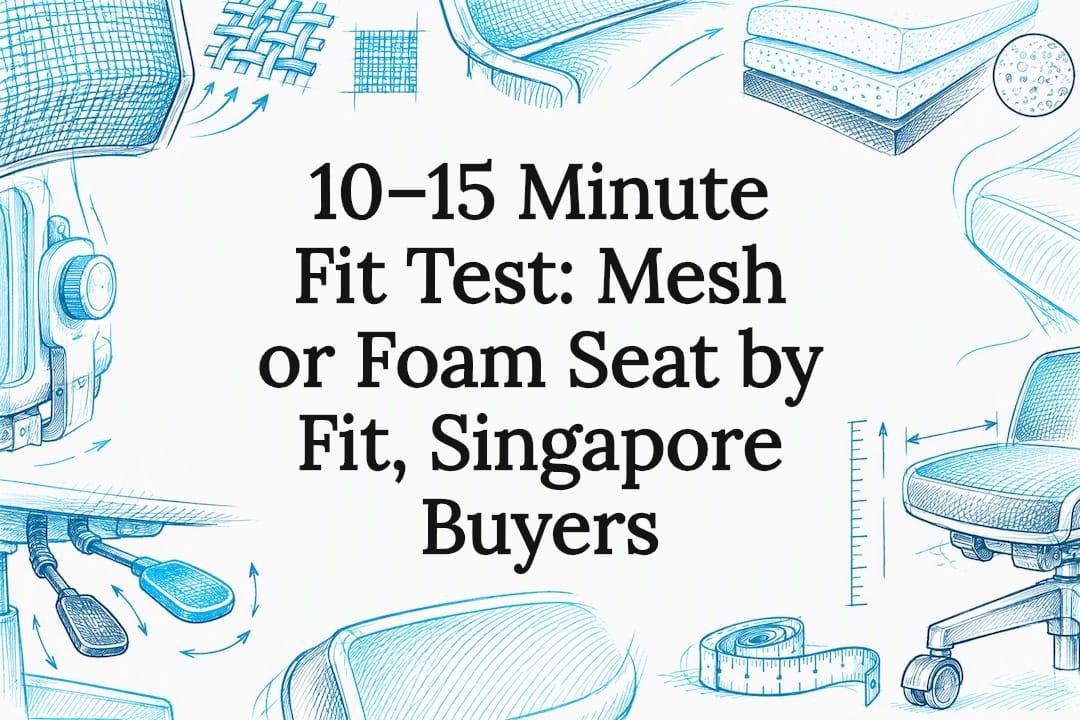
Mesh suits you if breathability and firm, suspended support matter most, while foam suits you if you prefer plush cushioning with a hugging feel. Most people who want both end up happiest with a hybrid, mesh back paired with a foam seat. Before you lock in a material, though, know that seat depth, lumbar support and adjustability usually shape your long-term comfort more than the fabric itself. The sections below walk through the evidence, the practical checks and the trade-offs so you can match the right build to how you actually sit.
TL;DR:
- Seat depth and adjustability are more critical for comfort and circulation issues than whether the chair uses mesh or foam material.
- Mesh chairs excel at breathability and moisture management, especially in warm or humid environments, while foam provides coziness and insulation.
- Both mesh and foam can cause similar tissue oxygen drops during prolonged sitting, with discomfort often linked to seat design rather than fabric type.
- Durability concerns differ: foam tends to compress and bottom out over time, whereas mesh can loosen and develop tears with use.
- A well-adjusted, properly fitted chair is more important for health and comfort than simply choosing between mesh or foam, with customization outweighing material choice.
Table of Contents
- How mesh and foam affect pressure, numbness and comfort
- Why mesh usually wins for breathability and staying cool
- Durability, sagging and how each material ages
- Why fit and adjustability matter more than the material you pick
- Hybrid seats and which profile fits you
- How we put this evidence into our chair designs
- Try or buy a chair built around your priorities
- FAQ
- Sources
How mesh and foam affect pressure, numbness and comfort
Foam and mesh handle your weight in different ways. Foam conforms around your body and cushions pressure points by compressing under load, while mesh suspends you across a taut weave that spreads weight through tension rather than depth. Neither approach is automatically better for your body, and the research backs that up.
A 2012 study on chair designs and sitting pressure measured tissue oxygen and carbon dioxide levels at the sit bones across different chair designs and found that design, not material, drove the biggest differences in pressure distribution. Foam chairs in the tested designs had higher average pressure and contact area, while some suspension designs produced lower average pressure, but the clinical measurements showed that both mesh and foam can cause similar drops in tissue oxygen during prolonged sitting. A 2022 study comparing seat material and comfort during computer-based tasks over a three-hour sitting session found no statistically significant difference in pain, comfort or fatigue between mesh and foam, though foam felt more supportive by the end and more participants overall said they preferred mesh.
What that means in practice: if you sink into a foam seat and feel pressure under your thighs, or you notice numbness on a mesh chair, the cause is often seat depth or a hard front edge rather than the material underneath you.
- A seat that's too deep pushes the front edge into the back of your knees, cutting circulation regardless of fabric.
- A sharp or unpadded front edge concentrates pressure on your thighs even on a well-cushioned seat.
- Sitting still for long stretches reduces blood flow to your sit bones on any seat type, mesh or foam.
Try this before blaming the material: sit for 10 to 15 minutes and check whether you can slide two to three fingers between the seat edge and the back of your knee. If you can't, the seat depth needs adjusting, not the fabric.
Pro Tip: Press your palm flat on the seat before buying. If you feel the frame through a thin foam pad, or the mesh sags loosely without resistance, that's a sizing or quality issue, not a verdict on the material family.

Why mesh usually wins for breathability and staying cool
If you run warm while you work, mesh is built for exactly that problem. Its open weave lets air pass through continuously, so heat and moisture move away from your body instead of building up against the seat. Foam, by contrast, traps warmth and humidity against your skin because it has nowhere to let air escape.
Practical testing from Tom's Guide confirms mesh's edge on breathability and notes that it's also easier to wipe clean, while foam feels cozier and more pliable, with a "hugging" quality that some people prefer over mesh's firmer suspension.
Many of the best-reviewed chairs now combine a mesh back with a foam seat, which lets you keep airflow where your back generates the most heat while retaining cushioning where you need support.
If you live somewhere warm or humid, a few adjustments help regardless of which seat you choose:
- Favour mesh or a hybrid seat if you sit for long stretches in a non-air-conditioned room.
- Choose a breathable fabric cover if you're set on foam, since some covers wick moisture better than others.
- Stand and stretch every hour or so to let air circulate under you, which helps on any seat material.
In cooler climates, the trade reverses slightly. Foam's insulating quality can feel genuinely pleasant in air-conditioned offices or colder months, since it doesn't carry away body heat the way mesh does.
Durability, sagging and how each material ages
Mesh and foam fail in different ways over time, and knowing the pattern helps you catch problems before they become a safety issue. Foam compresses with repeated use and eventually bottoms out, meaning you feel the hard frame beneath a seat that once felt plush. Mesh, instead of compressing, tends to lose tension gradually or develop small tears at stress points, particularly near the frame edges.
Industry testing standards like BIFMA X5.1 put office chairs through cyclic loading and structural tests to confirm the frame and mechanism hold up under repeated use. These standards are useful for judging structural durability, but they don't directly measure how long a specific mesh weave or foam density will resist wear on the surface you actually sit on. A chair can pass BIFMA's structural tests and still see its foam compress or its mesh loosen well before the frame shows any strain.
Certification confirms the frame and mechanism can take repeated stress. It says little about whether the seat surface itself will still feel right in five years.
Maintenance differs too. Mesh is easier to wipe down and resists staining better, but a tear is hard to patch invisibly. Foam absorbs spills more readily and needs a protective cover if you're prone to drinks at your desk, though small foam issues are generally easier to repair or re-pad than a torn mesh panel.
- Wipe mesh regularly with a damp cloth to clear dust that builds up in the weave.
- Use a removable, washable cover on foam seats if spills are a regular risk.
- Shift your sitting position through the day to avoid compressing the same foam zone repeatedly.
Heavier users and all-day sitters will see faster wear on both materials, so pay attention to how a seat feels after a few months rather than assuming first impressions will hold. Visible sagging, a mesh weave that no longer springs back, or a foam seat that bottoms out under normal weight are all signs it's time to consider a replacement or at least a reassessment of fit.
Why fit and adjustability matter more than the material you pick
Before you decide between mesh and foam, check whether the chair actually adjusts to your body. A well-built foam chair with proper seat depth and lumbar support will often outperform a basic mesh chair with none of those features, and the reverse holds just as true.
The adjustments worth checking, in order of impact: seat depth, lumbar support position, seat height, tilt tension and the shape of the front edge. Seat depth deserves particular attention because it's the single most common cause of numbness behind the knee, and that cause has nothing to do with whether the seat is mesh or foam. A seat that's too long for your thighs pushes into your knee joint no matter what it's upholstered in.
Here's a short sequence to run through when trial-fitting any chair, whether you're testing it at home or in a showroom:
- Sit all the way back so your lower back meets the lumbar support.
- Check for a two to three finger gap between the seat edge and the back of your knees.
- Adjust seat height until your feet rest flat and your knees sit roughly level with your hips.
- Test the tilt tension by leaning back, it should resist without feeling locked or floppy.
- Sit for at least 10 minutes and notice any new pressure points before deciding.
For a fuller walk-through of these settings, our guide to adjusting an ergonomic chair covers each control in detail, including how to fine-tune lumbar depth and armrest height alongside the seat itself.
Hybrid seats and which profile fits you
Hybrid construction, typically a mesh back combined with a foam seat, exists because it resolves the two biggest trade-offs at once: you get airflow where your back meets the chair and cushioning where your weight actually sits. Padded mesh, a thinner layer of foam bonded under a mesh cover, is another common variant that softens the firmness of pure mesh without losing all its breathability.
Matching material to how you actually use a chair helps more than chasing a single "best" option:
- If you work in a warm room for long stretches, lean towards mesh or a hybrid to manage heat build-up.
- If you game for multi-hour sessions, a padded mesh or hybrid seat balances support with the cooling you'll want during intense play.
- If you're sensitive around the tailbone or have a bonier build, a foam seat with contouring often feels gentler than taut mesh.
- If you're a heavier user prioritising long-term durability, focus less on the surface material and more on frame quality, foam density and the gauge of the mesh weave.
Pro Tip: If you genuinely can't decide, start with a hybrid. It rarely gets either job badly wrong, even if a pure mesh or pure foam seat might edge it out for one specific priority.
How we put this evidence into our chair designs
We design around the same principle the research points to: adjustability and build quality matter more than picking a single "winning" material. Our ergonomic chair range includes options pairing mesh backs against foam seats to provide airflow where needed and cushioning where your weight sits, alongside foam variants for those who prefer a padded feel.
Our chairs adjust for seat depth, lumbar position, height and tilt tension, as these controls influence comfort more than the surface material. We encourage a showroom visit or using an ergonomic chair finder to match a model against your body and workspace before committing.
— ULTI
Try or buy a chair built around your priorities
If you've read this far and recognise your own sitting habits in one of the profiles above, the next step is simple: come try the fit for yourself. Our ergonomic chairs range covers mesh, foam and hybrid builds with the adjustability this guide points to, so you're not choosing on fabric alone.
Whether you want a cooler mesh option for a warm room, a plush foam seat for a bony or tailbone-sensitive frame, or a hybrid that splits the difference, we can help you land on the right one:
- Book a showroom visit to sit in a few models before you decide.
- Use our chair finder to narrow options by body type and use case.
- Request our installation service if you'd rather have your new chair set up and adjusted for you.
FAQ
What are the disadvantages of using a mesh chair?
Mesh can feel firmer than foam, which some people find less plush over long sessions, and a torn mesh panel is harder to repair invisibly than a worn foam cushion. Reported numbness on mesh chairs is often caused by incorrect seat depth rather than the mesh itself, so checking fit first usually resolves the complaint.
Are mesh chairs actually comfortable?
Yes, for many people. A 2022 study on seat material and comfort found no significant difference in reported pain, comfort or fatigue between mesh and foam over a three-hour sitting session, and more participants in that study actually preferred mesh overall.
Which is more comfortable, a mesh chair or a cushion chair?
Neither material consistently wins on comfort. Research on chair design and pressure distribution found that design affects pressure more than material does, so a well-fitted chair in either material tends to outperform a poorly adjusted chair in the other.
What is the healthiest chair to sit in?
The healthiest chair is one that adjusts properly to your body, with correct seat depth, lumbar support and seat height, rather than one defined by a specific material. Pairing a well-fitted chair with regular movement breaks matters more for circulation and posture than whether the seat is mesh or foam.
Sources
- The effect of chair designs on sitting pressure distribution and tissue perfusion
- Mesh vs foam office chairs: which is more comfortable? | Tom's Guide
- BIFMA X5.1-2022 office chair testing requirements