
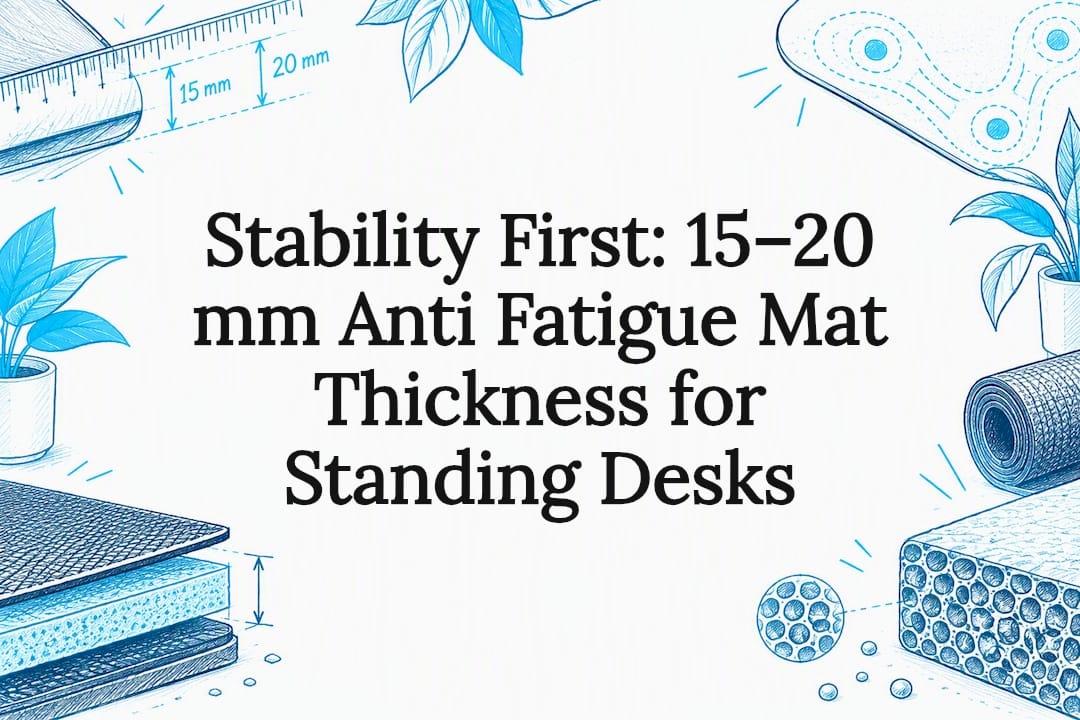
The best anti-fatigue mat thickness for most standing-desk and prolonged standing setups sits between 5/8 inch and 3/4 inch, or roughly 15–20 mm. That range balances cushioning with the stability your ankles need to stay comfortable over a full shift. Density and compression recovery matter just as much as the millimetres, though, and if you're on your feet in bursts, wear heavy work boots, or stand on wet industrial floors, you'll want to adjust from that starting point.
TL;DR:
- A 15 to 20 mm thick anti-fatigue mat offers the best balance for most standing desk users, providing cushioning without sacrificing stability.
- Dense construction and good compression recovery are more important than thickness alone, as low-density foam can flatten quickly and lose support.
- Mat stiffness, edges, and size should be chosen based on floor type, footwear, and standing duration to avoid instability and tripping hazards.
- Thicker industrial mats over 20 mm are suitable only for heavy-duty, dense materials and pose risks of instability for typical office environments.
- Regular in-use testing, paying attention to edges and ankle comfort, helps ensure the mat continues to support comfort throughout its lifespan.
Table of Contents
- What thickness ranges actually mean in practice
- Why does mat thickness affect comfort and fatigue?
- How do you match thickness to your standing time, footwear and floor?
- Why do density and compression recovery matter more than thickness alone?
- Getting the edges and placement right
- A short checklist before you buy
- Why trust Ulti on mat thickness and fit
- How should you think about mat thickness over the life of a desk?
- Get hands-on with mat thickness before you buy
- Sources
- FAQ
What thickness ranges actually mean in practice
Anti-fatigue mats fall into a handful of practical bands, and each one suits a different kind of standing.
- Under 10 mm (light-duty): thin enough for tight spaces under a chair mat or a quick perch, but they offer little relief over a full standing session and tend to feel flat within weeks.
- 10–15 mm (short bursts, soft floors): good for carpeted areas or intermittent standing, such as a reception desk you sit and stand at throughout the day.
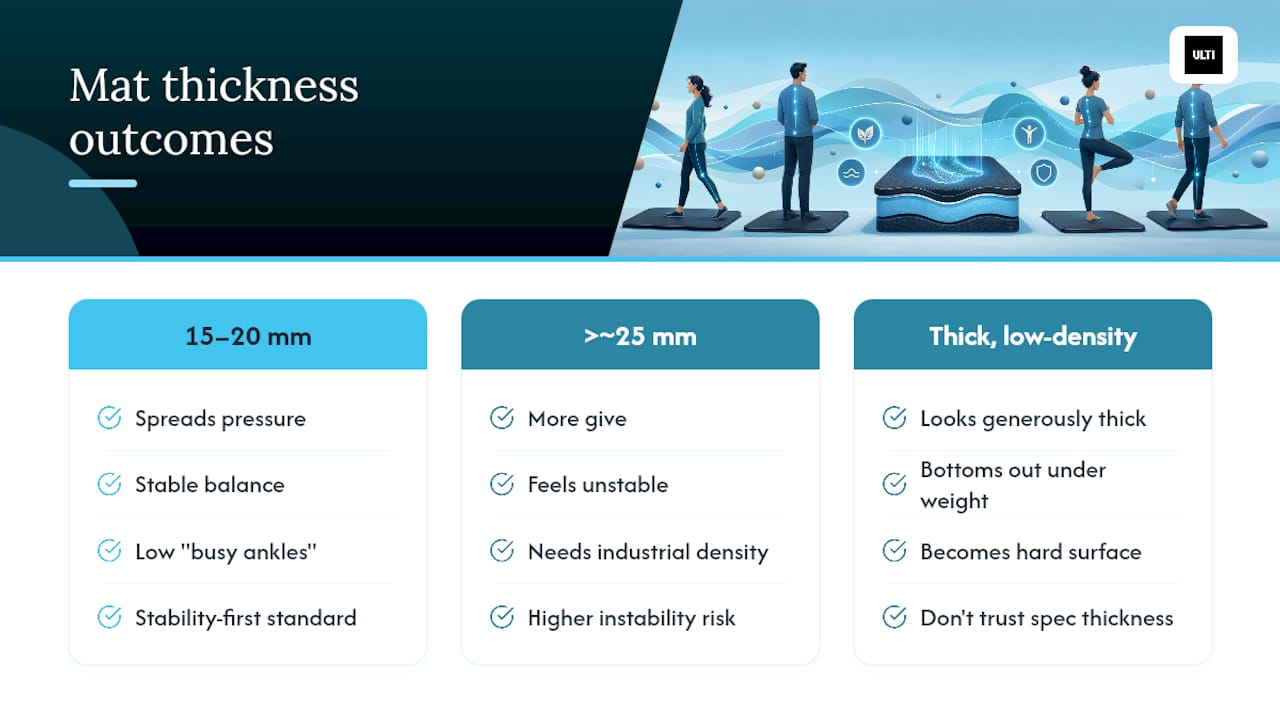
- 15–20 mm (general-purpose, the sweet spot): the recommended range for most desk and office standing use, offering enough give to cushion joints without letting your feet sink and wobble.
- 20–25 mm and above (heavy-duty, industrial): built for concrete floors and all-day factory or workshop standing, but only performs well when paired with a genuinely dense core.
Most manufacturers cluster their standard product lines somewhere between half an inch and just under an inch, and the real differentiation above half an inch tends to be construction and surface texture rather than thickness itself. Go too thin for your use case and you'll feel every hour on the floor. Go too thick without the right density and you risk a spongy, unstable surface that tires your legs faster than no mat at all.
Why does mat thickness affect comfort and fatigue?
A moderate thickness works because it spreads pressure across your foot without letting your ankle joints do extra stabilising work. That balance is the whole point of a standing mat: enough give to relieve pressure points, not so much that your body has to fight for balance.
Go too soft or too thick, though, and you get what's often called the "busy ankles" effect. Your lower leg muscles start firing constantly to correct tiny wobbles, and that micro-effort adds up across a shift. A stability-first standard around 15–20 mm reduces this risk, because mats above roughly 25 mm tend to feel unstable unless they're built from an unusually dense, industrial-grade material.
There's a second trap at the other extreme: bottoming out. Cheap, low-density foam mats that look generously thick on paper can compress fully under body weight within seconds, leaving you standing on what is effectively a thin, hard sheet with no real cushioning left. Thickness on a spec sheet tells you nothing about what happens once you actually stand on the thing for eight hours. That's why density and compression recovery deserve at least as much attention as the millimetre figure printed on the box.
How do you match thickness to your standing time, footwear and floor?
Your ideal thickness depends less on personal preference and more on three practical factors working together.
- Standing duration. Short bursts of standing (under two hours) tolerate a thinner 10–15 mm mat comfortably. Full shifts or all-day standing desk use benefit from the 15–20 mm range, since it holds up better once fatigue starts to set in around hour three or four.
- Floor type. Hard floors like tile, concrete, or polished timber usually need at least 15–20 mm of dense material to offer any real relief, because there's no give in the floor itself to help absorb impact. Carpeted or suspended timber floors can get away with slightly thinner mats.
- Footwear. Soft, cushioned trainers or slippers pair well with a mat at the lower end of the sweet spot, since your shoe is already doing some of the work. Hard-soled shoes, safety boots, or steel toe-caps need a thicker, denser mat to compensate, because rigid footwear transmits floor impact straight up through your joints.
Why do density and compression recovery matter more than thickness alone?
Thickness tells you how tall a mat is. Density and compression recovery tell you how it behaves once you've been standing on it for six hours. That distinction is where most buying mistakes happen, because a thicker mat built from cheap, low-density foam can perform worse than a thinner one made from a properly engineered material.
Density describes how tightly the material's cells or fibres are packed. Higher density generally means better long-term support and slower wear. Compression set is a related but distinct measure: it's the percentage of a mat's original thickness that fails to spring back after repeated loading. A mat with a poor compression-set rating will look fine in the shop but end up permanently flattened where you stand most, often within a year.
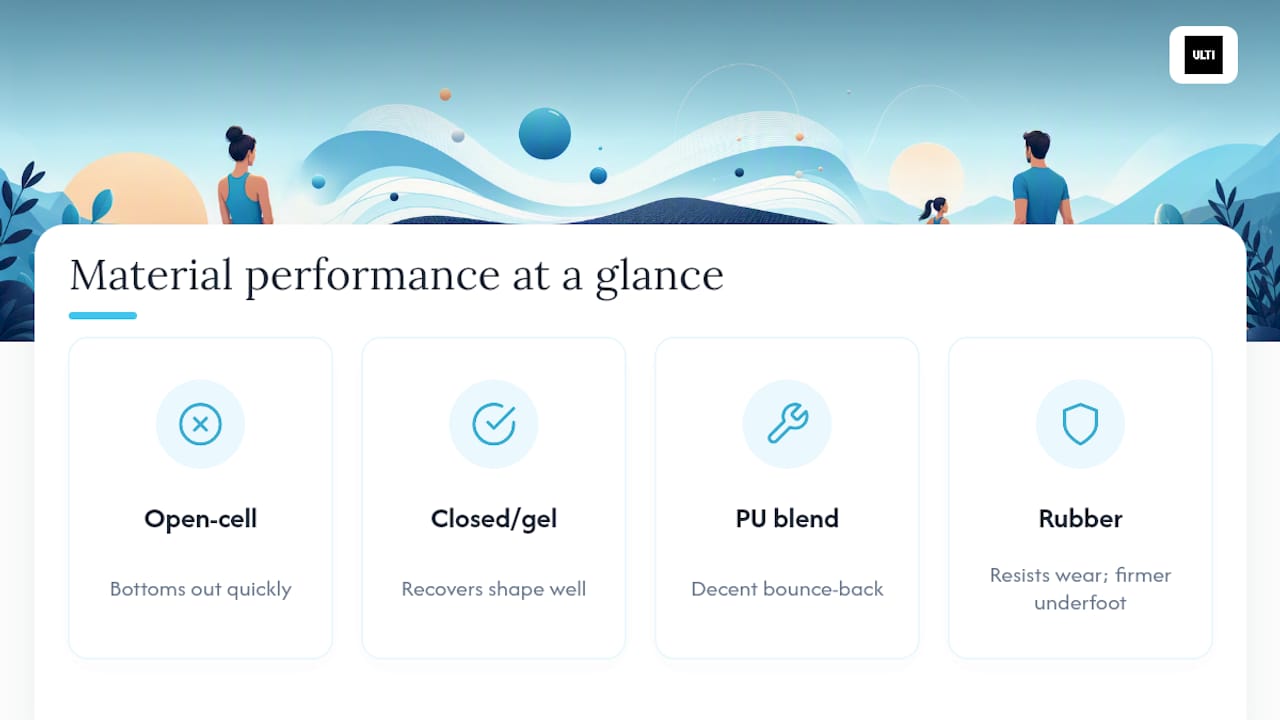
Foam mats vary hugely in quality: cheap open-cell foam bottoms out quickly, while denser closed-cell or gel-layered foams recover their shape far better. Polyurethane blends tend to sit in the middle, offering decent bounce-back at a reasonable price. Rubber, particularly in heavy-duty or wet-area mats, resists wear and holds its shape longest, though it's usually firmer underfoot from day one.
When you're comparing specs, look past the thickness figure for warranty language or a stated compression-set rating — that number is a far better predictor of how the mat will feel in year two than the millimetres alone.
Getting the edges and placement right
A thicker mat creates a taller edge, and a taller edge is a trip hazard the moment someone crosses it without looking down. This matters more than people expect in shared offices or walkways.
- Look for bevelled edges or ramped transitions on anything above 15 mm, particularly in areas with foot traffic or trolley wheels.
- Size the mat to your natural stance and small shifts, not just where your feet land when you're standing perfectly still. Most people drift and pivot more than they realise over a working day.
- Check periodically for curling corners, delamination, or a permanent dent where you stand most. These are early signs the mat's density has given out.
Pro Tip: Stand on a new mat for 30 seconds and pay attention to your ankles. If your lower legs feel like they're working to keep you steady, the mat is too soft or too thick for your floor and footwear, even if the thickness number looked right on paper.
A short checklist before you buy
Run through this before committing to any mat, whether you're buying online or trying one in a showroom.
- Confirm the thickness band matches your standing duration and floor type.
- Check for a stated density or compression-set figure, not just a thickness measurement.
- Look at the edge design and rule out any trip risk for your space.
- Confirm slip resistance and cleanability suit your environment, especially near kitchens or spill-prone areas.
- Read the warranty and return policy before you buy, since a genuine compression-set guarantee tells you the manufacturer trusts the material.
Then trial it properly: do the 30-second quiet-ankles check first, and if possible, stand on it for a full working block rather than just a few minutes in a shop. Matching the mat to your environment and inspecting it regularly once it's in use catches wear before it becomes discomfort. Replace it once you notice curling corners or a permanent indent that doesn't spring back.
Why trust Ulti on mat thickness and fit
Some manufacturers design standing desks, ergonomic chairs, and workspace accessories to work together as a system, not as isolated purchases. Anti-fatigue mats are part of that catalogue precisely because a desk that raises and lowers smoothly still leaves you standing on a hard floor without one.
Readers weighing up thickness and density in the abstract can see and stand on the options directly at Ulti's showroom guide to anti-fatigue mats, where sizing and material questions get answered against real standing desks rather than a spec sheet alone.
How should you think about mat thickness over the life of a desk?
Chasing maximum thickness is the wrong instinct. A moderate, dense mat that holds its shape after a year of daily standing beats a thicker, softer one that bottoms out by month three. Treat the mat as part of your whole workstation, not an afterthought, and re-test it the same way you'd check any other piece of kit: stand on it properly, watch what your ankles do, and replace it the moment it stops springing back.
— ULTI
Get hands-on with mat thickness before you buy
Reading about density and compression recovery only gets you so far. Some companies sell anti-fatigue mats and accessories designed to pair with standing desks, and potential buyers can feel the difference between a 15 mm and a 20 mm mat in person at certain showrooms before purchasing.

If you already know your standing pattern and floor type, browse the anti-fatigue mat range directly and check the density and edge details against the checklist above. For anyone building a full setup, the standing desks and accessories catalogue shows how a mat, desk height, and cable routing all fit together in one workstation. Book a showroom visit or place an order online, whichever suits how you like to shop.
Sources
- Anti Fatigue Mat Thickness Guide
- Standing Desk Mat Thickness Guide: The Stability-First Standard (15–20mm) + The “Trap” Signs - Worknest Studio
- Anti-Fatigue & Safety Matting Buyer's Guide | CustomMHS
- Anti-Fatigue Mat Thickness Guide: 9mm, 12mm, 20mm or 25mm? | Maximum Matting
- What to Look for When Buying an Anti-Fatigue Mat (CCOHS guidance)
FAQ
How thick should an anti-fatigue mat be?
For most standing-desk and office use, aim for 5/8 to 3/4 inch, or roughly 15–20 mm. Adjust down for short standing bursts on soft flooring, or up for heavy-duty industrial use with dense materials.
What is the thickest anti-fatigue mat you can buy?
Heavy-duty and industrial mats typically top out around 3/4 to 1 inch, and need denser rubber or polyurethane construction with bevelled edges to stay safe and effective at that height. Beyond an inch, most mats become impractical for everyday standing desk use due to trip risk and instability.
Is a 10 mm mat too thick for yoga?
No, 10 mm sits within the common range for yoga and light exercise mats, since that use prioritises grip and joint comfort over the standing-stability concerns that apply to workplace mats. A 10 mm mat is generally too thin for a full day of standing desk work, where 15–20 mm performs better.
What are some good 1-inch thick anti-fatigue mats?
A 1-inch mat only performs well when it's built from dense rubber or polyurethane designed for heavy-duty or wet industrial areas. For desk work, a thinner 15–20 mm mat with strong compression recovery, like Ulti's anti-fatigue mat, usually feels more stable underfoot than a full inch of softer foam.